
Complete assembly of the kitchen set: from preparation to final adjustment
Kitchen assembly is a responsible process, requiring careful preparation and adherence to a certain sequence of actions. A well-assembled kitchen set will not only last for many years, but will also make the cooking process comfortable and enjoyable. Let's look at all the assembly stages in detail, paying attention to important nuances and professional tricks and we will find performers
Preparing to assemble the kitchen set
Before starting installation work, it is necessary to create optimal conditions for assembly and check all components. Proper preparation will significantly speed up the process and help avoid common mistakes. The correct kitchen assembly sequence will ensure durability and ease of use. If you have no experience in furniture assembly, It’s better to entrust the work to professionals https://hands.ru/service/sobrat-kuhnyu/
Basic preparatory activities:
- thorough check of the complete set according to the attached specifications;
- preparation of the necessary tools;
- organization of work space;
- performing preliminary marking.
Required tools and materials
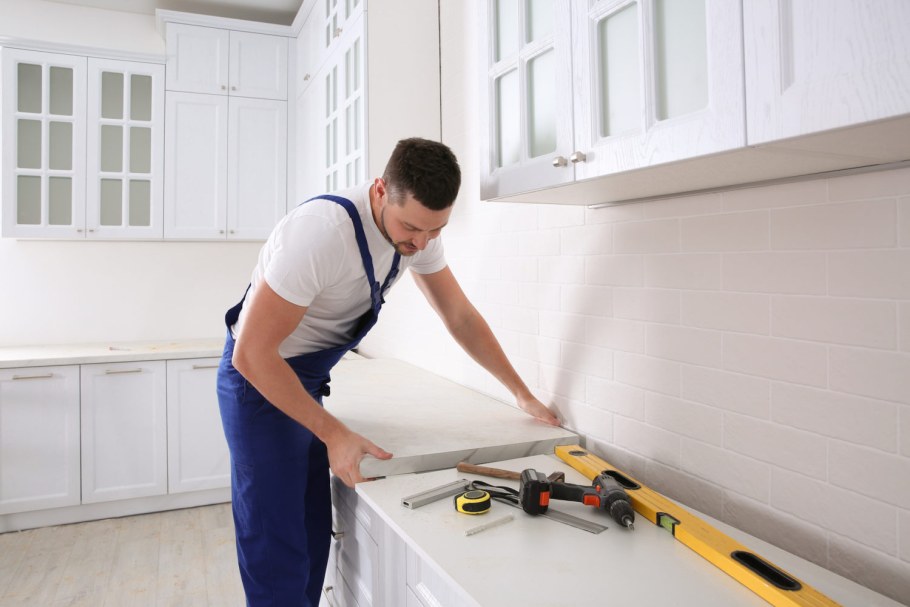
High-quality kitchen installation is impossible without the use of professional tools and consumables. Experts recommend preparing a complete set in advance.
Basic set of tools:
- screwdriver with bit set;
- building level no less than 60 cm;
- tape measure and square;
- drill with a set of drills;
- pencil and masking tape;
- sealant mounting gun.
Assembling the lower kitchen modules
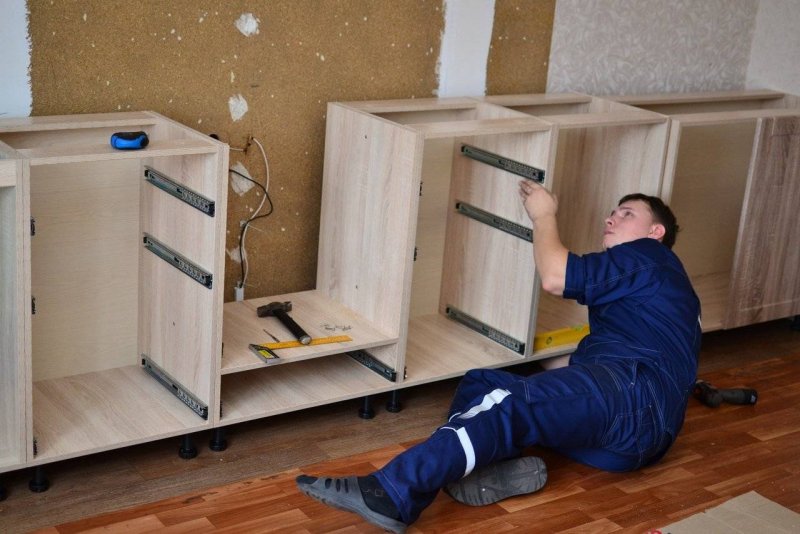
Installation of a kitchen set traditionally begins with the lower sections, which form the basis of the entire structure. This stage requires special care, since the stability and durability of the kitchen depends on it.
Step-by-step assembly technology:
- assembly of the frame of each cabinet with the connection of the side walls, bottom and back panel;
- installation of adjustable legs with the possibility of subsequent fine adjustment;
- installation of guide mechanisms for drawers;
- assembly and installation of drawers with checking smooth movement;
- fastening facade elements using high-quality fittings;
- alignment of all modules to building level.
Installation of wall cabinets
Installation of the upper sections requires special precision and attention to detail. Properly installed wall cabinets should form a straight line and provide easy access.
Key points of installation:
- precise marking of cabinet positions taking into account ergonomics;
- use of reliable fastening systems;
- checking the horizontality of each element;
- connecting adjacent modules with special ties;
- final installation of facades and adjustment of hinges.
Installation and adjustment of the tabletop
The countertop is the most important functional element of the kitchen, requiring a special approach to installation. High-quality installation will ensure the durability and aesthetic appearance of the work surface.
Technological stages:
- exact size adjustment taking into account all technological cutouts;
- secure fixation on base cabinets;
- professional processing of joints and ends;
- installation of connecting and end strips.
Installation of apron and decorative elements
Finishing work gives the kitchen a finished look and provides additional protection for the walls from moisture and dirt.. Decorative elements emphasize style and create a harmonious image.
Main works:
- attaching a protective apron of the selected type;
- installation of plinth panels;
- installation of handles and other fittings;
- connecting and setting up the backlight.
Check and final adjustment
The final stage of assembly guarantees the flawless operation of all mechanisms and elements of the kitchen. Professional adjustment ensures comfortable use for many years.
Control activities:
- checking the smooth running of all retractable elements;
- precise adjustment of door hinges;
- stability control of the entire structure;
- testing the operation of embedded equipment.
Features of installing kitchen appliances
A modern kitchen is unthinkable without built-in appliances, installation of which requires special knowledge and skills. Correct installation ensures safety and long service life of the equipment.
important aspects:
- compliance with ventilation requirements;
- ensuring free access to communications;
- use of special fastening systems;
- precise positioning relative to furniture modules.
Professional advice and recommendations
Experienced kitchen assemblers share their secrets, that will help you avoid common mistakes and achieve perfect results. These recommendations are especially useful for those, who decided to assemble the kitchen themselves.
Valuable recommendations:
- Always start assembly by checking the contents;
- don’t skimp on quality fittings;
- use a level at every stage of installation;
- leave technological gaps to compensate for thermal expansion;
- trust the connection of embedded equipment to professionals.
Conclusion and warranty
A properly assembled kitchen will become a comfortable workspace and a source of pride for the owners.. Compliance with installation technology is the key to long and trouble-free operation of furniture.
Important final points:
- checking all connections and fastenings;
- study of warranty conditions;
- familiarization with the rules of caring for kitchen units;
- drawing up a work completion certificate (with professional assembly).